Crypto Trading with Moving Averages
Cryptocurrency markets are known for their speed, volatility, and emotional swings. Traders need structured methods to interpret price action without reacting impulsively. One of the most practical tools for this purpose is the moving average (MA).
Moving averages smooth out price fluctuations and reveal the broader trend. Whether you trade short-term altcoin breakouts or long-term Bitcoin trends, moving averages help transform chaotic charts into readable signals.
What Is a Moving Average?
A moving average is a technical indicator that calculates the average price of an asset over a specific number of periods. As new data appears, the average updates, creating a flowing line on the chart.
There are two primary types used in crypto trading:
1. Simple Moving Average (SMA)
The SMA calculates the arithmetic average of closing prices over a set period.
-
50-day SMA = Average closing price of the last 50 days
-
200-day SMA = Average closing price of the last 200 days
It reacts slowly to price changes and is commonly used for identifying long-term trends.
2. Exponential Moving Average (EMA)
The EMA gives more weight to recent prices, making it more responsive to market shifts.
-
9 EMA and 21 EMA are popular for short-term trading
-
50 EMA and 200 EMA are used for broader trend analysis
Because crypto markets move quickly, many traders prefer EMAs for shorter timeframes.
Why Moving Averages Matter in Crypto
Unlike traditional markets, crypto trades 24/7. This constant activity produces more noise and false signals. Moving averages reduce that noise and help traders:
-
Identify trend direction
-
Detect potential reversals
-
Confirm entry and exit points
-
Filter emotional decision-making
-
Align trades with broader momentum
Instead of guessing market direction, traders can rely on objective data.
Popular Moving Average Strategies in Crypto
Moving Average Crossover Strategy
This strategy uses two moving averages — typically one short-term and one long-term.
-
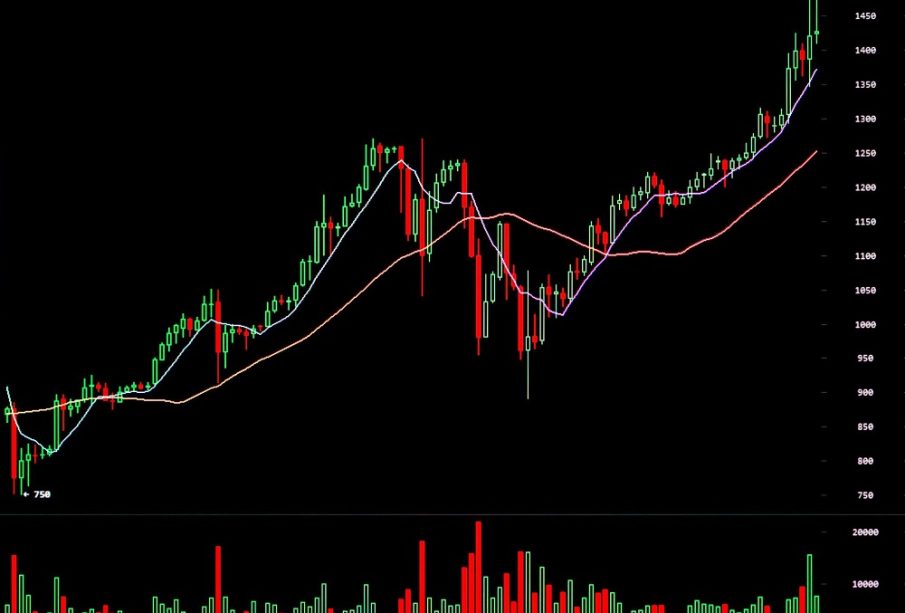
Golden Cross: Short-term MA crosses above long-term MA → Bullish signal
-
Death Cross: Short-term MA crosses below long-term MA → Bearish signal
Example setup:
-
50 EMA crossing above 200 EMA = Potential long entry
-
50 EMA crossing below 200 EMA = Potential sell signal
Crossovers work best in trending markets but can generate false signals in sideways conditions.
Trend-Following Strategy
When price consistently stays above a moving average, it indicates strength. When it remains below, it suggests weakness.
Common approach:
-
Buy when price pulls back to the 50 EMA during an uptrend
-
Sell when price retests the 50 EMA in a downtrend
This method allows traders to enter with the trend rather than chasing breakouts.
Dynamic Support and Resistance
Moving averages often act as dynamic support and resistance levels.
-
In uptrends, price may bounce off the 20 or 50 EMA
-
In downtrends, these levels may act as resistance
This behavior is especially visible on high-liquidity cryptocurrencies like Bitcoin and Ethereum.
Choosing the Right Timeframe
Your trading style determines the most effective moving average settings.
Scalpers
-
9 EMA
-
20 EMA
-
5–15 minute charts
Day Traders
-
20 EMA
-
50 EMA
-
1-hour charts
Swing Traders
-
50 SMA
-
100 SMA
-
4-hour or daily charts
Long-Term Investors
-
200 SMA
-
Weekly charts
There is no universal setting. Backtesting helps determine which works best for your strategy.
Combining Moving Averages with Other Indicators
Moving averages are powerful, but using them alone may lead to false signals. Many traders combine them with:
-
RSI (Relative Strength Index) to measure overbought or oversold conditions
-
MACD (Moving Average Convergence Divergence) for momentum confirmation
-
Volume analysis to confirm breakout strength
-
Support and resistance zones for precise entries
Confluence improves probability.
Common Mistakes Traders Make
Even though moving averages are simple, misuse can reduce effectiveness.
Overloading the chart
Adding too many MAs creates confusion rather than clarity.
Ignoring market structure
Moving averages lag. They follow price; they do not predict it.
Trading crossovers in sideways markets
Whipsaws are common when price lacks direction.
Using the same settings for all coins
Low-cap altcoins behave differently than large-cap assets.
Risk Management with Moving Averages
A strong signal does not eliminate risk. Every trade should include:
-
Stop-loss placement below key moving averages in long trades
-
Position sizing based on account risk tolerance
-
Avoiding over-leveraging in volatile environments
-
Confirming signals across multiple timeframes
Risk control matters more than indicator precision.
Are Moving Averages Effective in Crypto?
Yes — when applied correctly and with discipline.
They work best in trending markets and when combined with volume or momentum indicators. They are less reliable during consolidation phases.
Moving averages provide structure. They do not guarantee profits, but they improve decision-making.
FAQ Section
1. What is the best moving average for crypto trading?
There is no single best option. Short-term traders often prefer the 9 or 20 EMA, while long-term investors rely on the 200 SMA.
2. Do moving averages work in highly volatile markets?
They work best during sustained trends. In choppy markets, they may generate false crossover signals.
3. Should beginners use SMA or EMA?
Beginners may start with SMA because it is simpler. However, EMA reacts faster and is commonly used in crypto trading.
4. Can moving averages predict market crashes?
No. Moving averages are lagging indicators. They confirm trends but do not predict sudden events.
5. How many moving averages should I use on one chart?
Two or three are sufficient. Adding more often leads to analysis paralysis.
6. Are moving averages suitable for automated trading bots?
Yes. Because they are rule-based indicators, they are frequently integrated into algorithmic strategies.
7. Do moving averages work for all cryptocurrencies?
They work best on high-liquidity coins. Low-volume tokens may produce unreliable signals due to erratic price movements.